One of the questions I’m most frequently asked in Korea is, “How old are you?” Korea has very strong roots in Confucianism, therefore seniority based on age is very prevalent not in just people’s relations with one another but also in companies, schools and sports teams. Even if the age difference is only one year, the younger person is expected to respect to their elder through speech, body language and gestures, no matter what. I still find myself in a state of shock when Ahjummas (older Korean women) literally push, shove, and elbow their way through a crowd or step in front of you not just in line, but when you are actually at a ticketing window, despite the fact that you might be midway through a transaction. When taking a look around after witnessing this, however, no one bats an eyelash at how rude those actions may be. It’s just the way it is. You’ll see younger people bowing to their elders and addressing them with certain titles and formal language to distinguish rank. It is also customary to pour drinks for those older than you and to let them eat, sit and stand before you as well. Unfortunately (at least that’s they way I see it) this ranking system plays a very large role in the business world as well–positions, pay and ranking almost always go hand in hand with age, regardless of experience.
Adding to the complexity of Korea’s hierarchical system is the difference between Korean age and Western age. Koreans believe you are born at age one (that’s a really long pregnancy…) and they do not use their birth date to determine when they turn a year older. Instead, everyone turns one year older the first day of the new year, January 1. I have not been in Korea to ring in the new year yet, but I wonder if it feels like one giant birthday party?
I turned 30 not long after arriving in Korea, which means I was actually already 30 in Korean age when I got here and am now 31…I think I’ll stick with Western age. However, I usually get a surprised response when I reveal my age, which I’ll take as a good thing. Upon meeting my co-teacher for the first time after she asked how old I was, she responded, “Oh, wow. Westerners usually look old, but you don’t. You must eat a lot of vegetables.” Yes, I do. And I think the kimchi is now helping out as well.
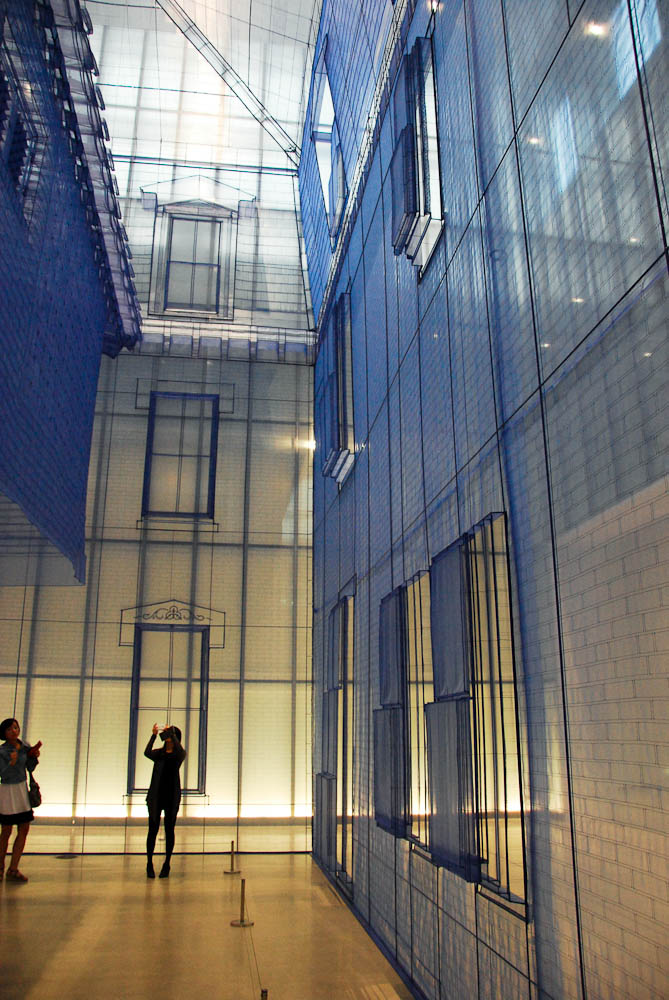
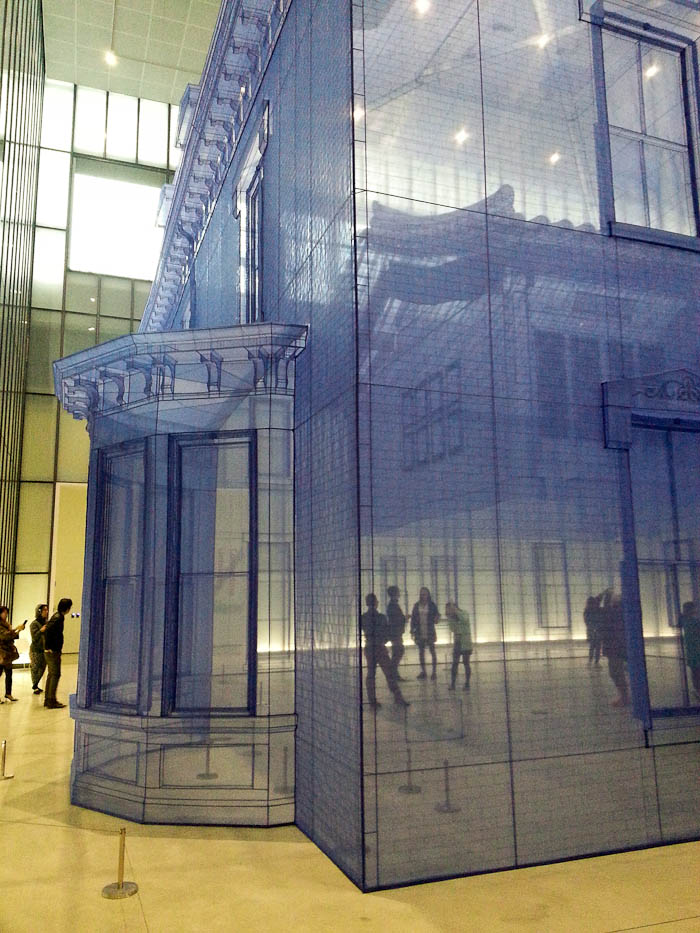
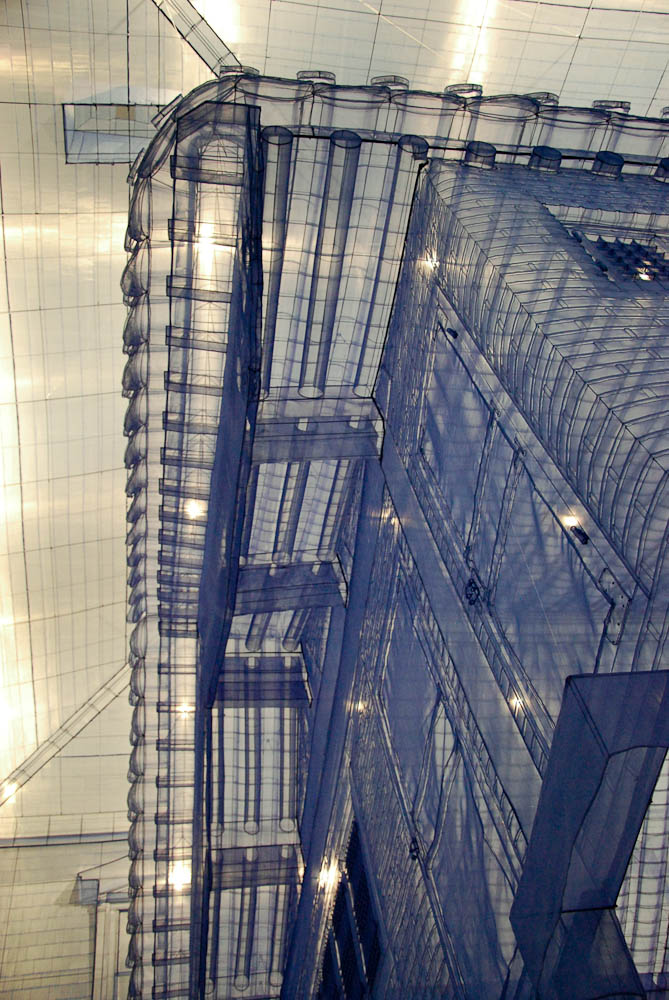
My very first visit to Seoul included a stop at the newly constructed branch of the National Museum of Modern and Contemporary Art, Korea. I heard there was an installation by Do Ho Suh that would only be up for a few more months, and I could not wait to see it. I was already familiar with his pieces from working at the Seattle Art Museum, which held his first retrospective in 2002. While I did not work there in 2002, I did get to witness the installation he created for SAM in 2011 titled Gate, a multimedia piece based on the gate outside his parent’s home in Seoul and a few pieces in SAM’s beautiful Asian art collection. It blew me away, as I’d never seen anything quite like it before. I was equally blown away by the installation in Seoul called Home within Home within Home within Home within Home, a life-size fabric reproduction of his first residence in the United States and his family’s traditional Korean house hanging in the middle.

Do Ho Suh’s Home Within Home Within Home Within Home Within Home at the National Museum of Modern and Contemporary Art, Seoul.
Do Ho Suh (서도호) is a Korean artist, mostly known for his sculptures, who now splits his time between New York, Seoul and London. Most of his work is site-specific (or at least context-specific) and often focuses on the idea of personal space and identity. I am most impressed with his architectural pieces in which he uses fabric, creating a delicate space that can be occupied by the viewer. Home within Home within Home within Home within Home is one of them where he beautifully demonstrates time and space and the memory of home with a ghost-like quality. The shear fabric in a calming blue color reveals the past and the present in such a surreal manner, and the transparency forces you to look at the relationship between individuals and the notion of private versus public.

Home within Home within Home within Home within Home: traditional Korean house within Western-style house; Western-style house with Seoul Box; Seoul Box within the Seoul branch; the Seoul branch within Seoul.

The front door of the house where Do Ho first lived when he got to the United States in Providence, Rhode Island.

The photo is a bit blurry, but you can even see Do Ho’s name on what would have been the building directory.

Looking up at Do Ho’s traditional Korean house hanging within his first home in the United States, I felt especially connected to this exploration of identity, space and presence of culture shock as I adjust to life in a foreign country that is very far from what I call home.

Beautiful detail by Do Ho Suh in Home Within Home Within Home Within Home Within Home at the National Museum of Modern and Contemporary Art in Seoul.
If you ever have a chance to see anything by Do Ho Suh, I strongly encourage you to do so. There are elements of sentimentality to his work that are very thought-provoking and I’m not very good at describing them. I think you will be impressed.
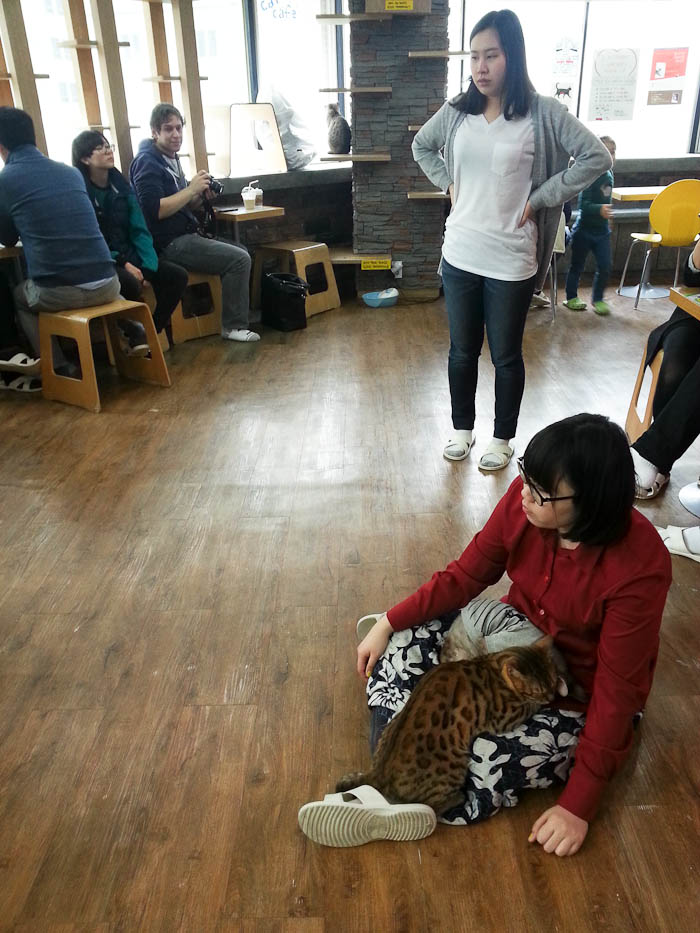
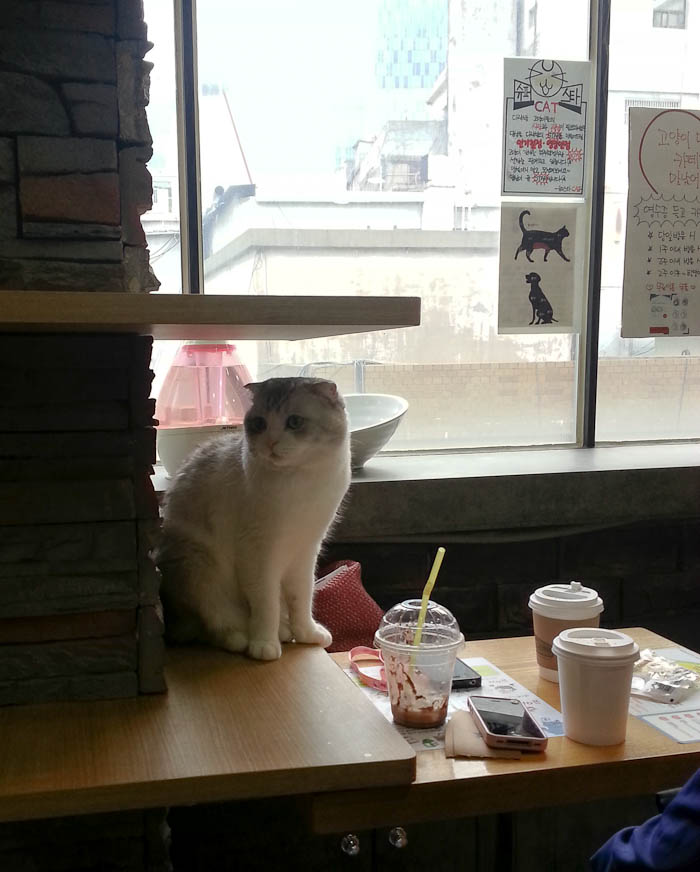
I love cats, and I miss mine dearly (had to leave him behind when I came to Korea), so when I heard there were places called cat cafes in Korea I just had to check it out. You won’t find them in small towns like the one I live in, but nearly all the larger cities have them. I went to one in Myeongdong in Seoul and even though I’d never heard of the concept until I got here, it was pretty close to how I imagined it would be–a coffee shop with cats roaming, playing and napping all over the place. It was awesome.
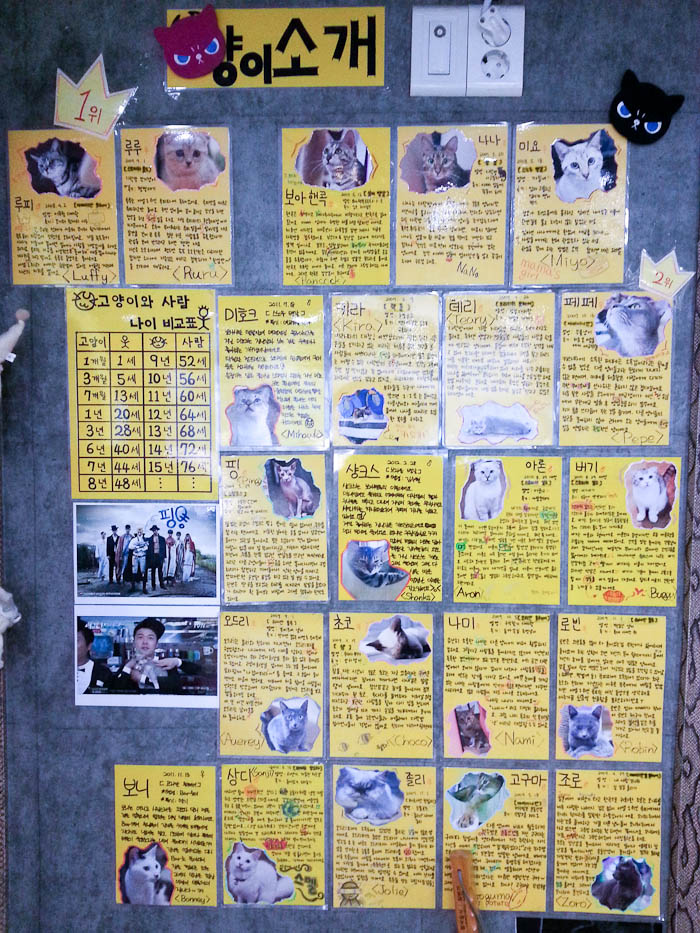
After taking my shoes off at the door, I paid 8,000 won to enter (just under $7) which included one free coffee drink or tea. Then I sat down and enjoyed my green tea latte while admiring the 22 different cats in the cafe.

The cat cafe rules: do not hug the cats (especially if you look like an alien), do not disturb sleeping cats, no pulling cat tails, turn off your camera flash, do not touch the cats while they eat, don’t pat the cat’s bottom, don’t feed the cats anything except cat treats, and don’t tease the cats with straws.
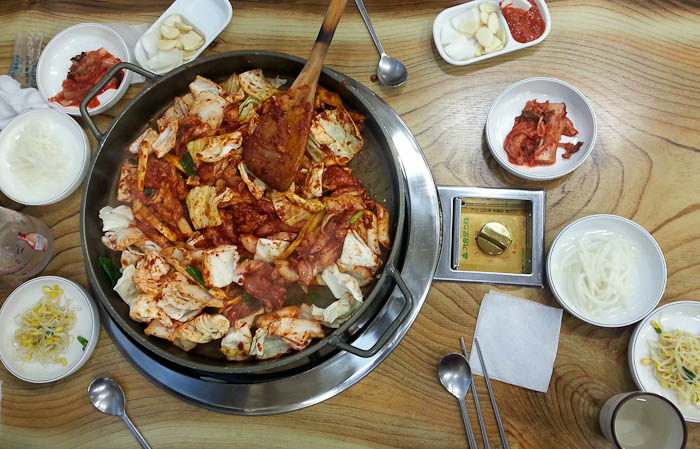
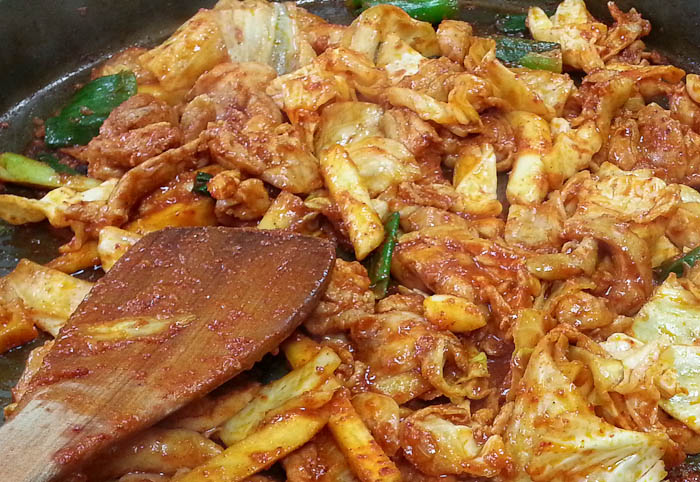
This healthy Korean dish is another one of my favorites so far, and I haven’t even tried it in its originating city yet. Dak galbi, which translates to chicken ribs despite the fact that chicken thigh or breast is usually used, is a specialty of Chuncheon in Gangwon Province. It consists of marinated diced chicken cooked in gochujang (hot pepper paste) along with green onions, sweet potato, cabbage, and tteok (rice cake). It’s quit spicy (surprise!) but oh-so-flavorful. Like many Korean dishes, it’s cooked at your table and is meant to be shared. Oftentimes dak galbi is served with leaves of lettuce as well as ice cold bowls of pickled radish for when the heat really gets to you.
The day started out like any other Monday in Korea. I taught three classes before lunch, then prepared for three more in the afternoon. On the way back to my classroom from the cafeteria, my co-teacher and I are stopped by another teacher and they have a five minute conversation in Korean. I hear my name a few times so I smile and nod, pretending I vaguely know what they are talking about even though I have no idea. It’s then relayed to me, very simply, that I have to take a “business trip” to Cheongju. Today. I look at my watch, it’s 12:55. Cheongju is an hour away by bus which runs infrequently in the afternoons.
Ok, so I assume my afternoon classes will be cancelled?
Yes.
What is the business trip for?
A cultural class.
Oh, ok. When does it start?
At 3 maybe.
At 3, maybe?
Yes maybe.
Uh, ok.
We then go speak to the vice principal, who doesn’t seem very happy about this business trip. The two teachers and the vice principal carry on a 20 minute conversation that feels quite fierce. There seems to be some confusion with paperwork. Again, I stand there smiling and nodding, trying not to look like I am so confused about what is going on right now (all I could think was how intense this seemed for a last minute cultural class and why am I just now hearing about this). My co-teacher decides to go with me to Cheongju to show me where the business meeting is since I have no idea how to get there. Turns out neither does she. After taking a bus to Cheongju, asking a few people for directions at the bus terminal, hopping on a local bus for a few kilometers, getting off the bus, getting in a taxi, getting out of the taxi only to discover a few minutes later we are at the wrong place on the opposite side of the city, getting in another taxi, then wandering around two huge buildings, we finally arrive at 3:45 (I hate being late!) when the meeting started at 3, maybe. My co-teacher leaves me to attend the business meeting or what I understand to be a Korean cultural class. More like Korean surprise! This is not in fact a class to learn about Korean culture. This is a meeting to discuss the guidelines of the class I am teaching about American culture to middle school students in various schools throughout the county. Oh, I see, I volunteered to teach cultural classes. Maybe? Yes maybe.
Aside from the language barrier, I think the most challenging part of living in Korea has been learning how to deal with varying degrees of Korean surprises. Things tend to change or happen last minute and there are quite a few aspects of Korea that don’t seem to make sense logistically. There have been times when I’ve quickly become faced with awkward, frustrating situations that have pulled me completely out of my comfort zone. I can certainly be flexible, but I will say I’ve always been a pretty organized planner. So when I was suddenly told I had a business trip in another city, immediately, and that’s all the information I got (I still have no idea what went on between the teachers that day, or why I had no knowledge about volunteering to teach extra cultural classes) my initial reaction was to freak out and demand to know why I was just receiving this information. But I’ve encountered quite a few circumstances similar to this in the past three months that have required me to pause, take a deep breath and trust that everything will be just fine in order to avoid a meltdown, as that won’t get me anywhere in Korea.
Sometimes it’s frustrating tidbits of everyday life, like the bank requiring you to have a local phone number to set up and account and the phone company requiring you to have a local bank account to activate a phone. Huh? Or walking into the teacher’s lounge first thing in the morning and finding out it’s hiking day as you look down at the dress and tights you’re wearing. Or being told on Tuesday you don’t have to teach classes on Wednesday so you don’t prepare anything, only to hear on Wednesday morning you will actually be teaching and class started five minutes ago. I have definitely had my moments of hair-pulling, cursing and crying (mostly in private), but I am getting better at recognizing the things I can’t control and just taking a breath, putting a smile on my face, and giving thanks for having the opportunity to live and work abroad so I can enjoy my pocketful of delicious kimchi. If that doesn’t work, I attempt to laugh without smiling. It works every time (thanks, David).
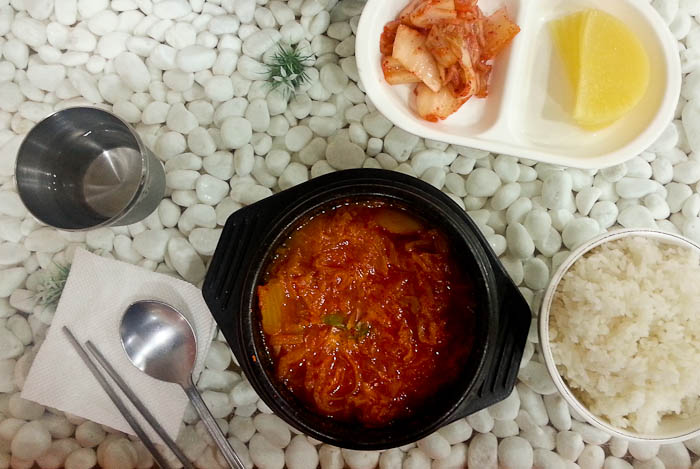
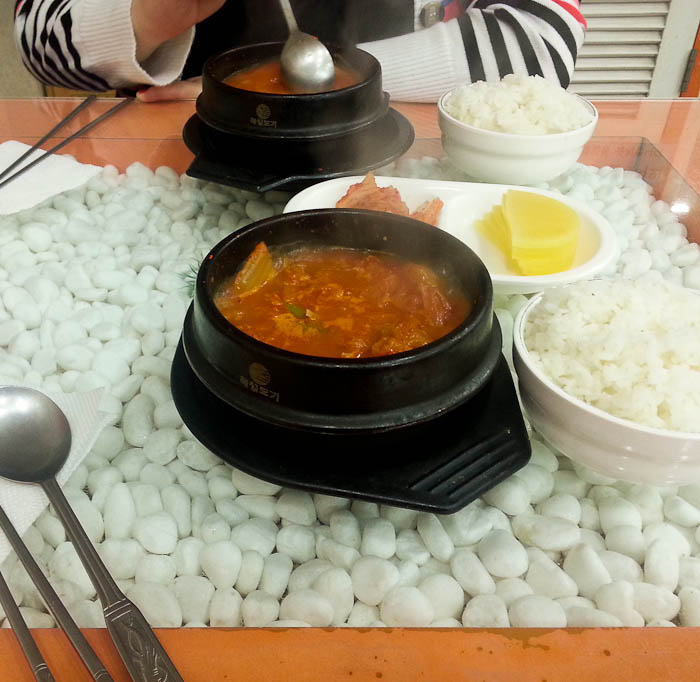
What do you do when your fermented cabbage becomes a little too fermented? Make a soup! At least that’s what Koreans do and it’s delicious. Kimchi jjigae is one of my favorite Korean dishes so far. Right now I’d say I could eat it everyday and not get tired of it (ask me again when summer comes).
Jjigae, meaning soup or stew, is a regularly consumed dish in Korea and there are many different varieties, although kimchi jjigae is the only type I’ve tried so far. The more fermented the kimchi the better, as it creates a fuller flavor. Tofu, green onions, and pork are often included and it’s seasoned with garlic and dongjang (bean paste) or gochujang (red pepper paste). As you can imagine, it’s quite spicy. You also might think it would taste quite sour (you are eating aged kimchi), however I don’t find it to be at all. In fact, I forget that I’m even eating kimchi by the spoonful. The combination of the pork, veggies, gochujang and kimchi boiling in one pot creates an awesome flavor.
Aside from my experience during a four week TEFL course in Thailand–Samui TEFL, a program I highly recommend–I had never taught before coming to Korea. Surprisingly, teaching experience is not a requirement to teach for the English Program in Korea, you just have to hold a four year degree in, well, anything. I was a bit nervous during the first week or two of teaching here, however I’ve settled into the daily routine and am finally getting the hang of it…I think. Midterms are next week, we’ll see how their English scores are (yes, elementary students in Korea take midterms).
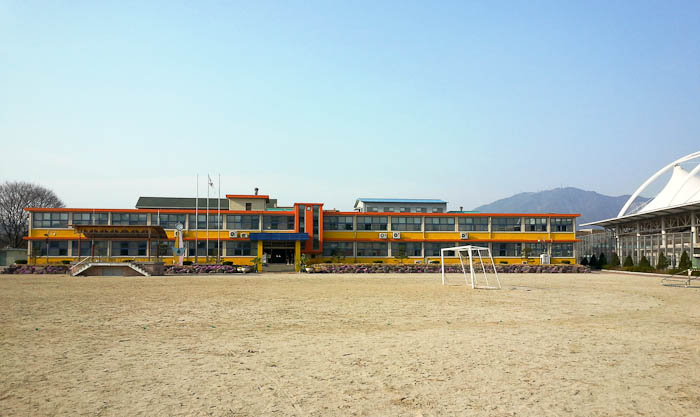
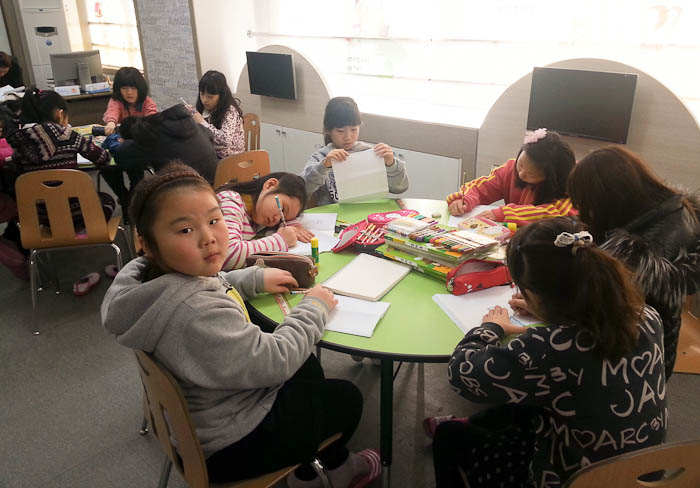
I teach at two different schools which first sounded quite overwhelming to me, but it actually adds some variety to my week and let’s me experience both a small school and a really small school. I have one co-teacher at each school that aids in teaching and interpreting. My main school, Namshin Elementary, is just a five minute walk from my apartment making my commute a breeze. I teach there on Mondays, Tuesdays and Thursdays. My day starts at 8:30 am and wraps up at 4:30, however my hours spent teaching in the classroom vary each day. This semester at Namshin I’m teaching grades 4 – 6 and have about 24 – 29 students per class. On my busiest day I teach 6 classes, on my quietest day I teach just 3.
My second school is Daejang Elementary which is about a fifteen minute car ride north of Eumgseong. The 6th grade homeroom teacher lives in my apartment complex so she kindly gives me a ride when I teach there on Wednesdays and Fridays. Daejang only has 43 students in the entire school, so my class sizes for grades 3 – 6 range from 5-8 students which I really enjoy. I’ve actually been able to learn all their Korean names.
When I’m not teaching my day is spent lesson planning, desk warming (code for look busy when you don’t have anything to do) and playing volleyball with the other teachers and principal. And by volleyball I mean the kind where it’s totally cool to kick the ball over the net and score a point. Lunchtime, which I thoroughly look forward to everyday and do in fact miss on the weekends, starts promptly at 12:10 each day. Even though I don’t know what I’m eating sometimes, I will say the meals are delicious and healthy (more on that later). Just the other day I was told by my vice principal that I have excellent chopstick skills. Now I just need to work on my Korean language skills, as I never would’ve understood the compliment had it not been translated by my co-teacher.
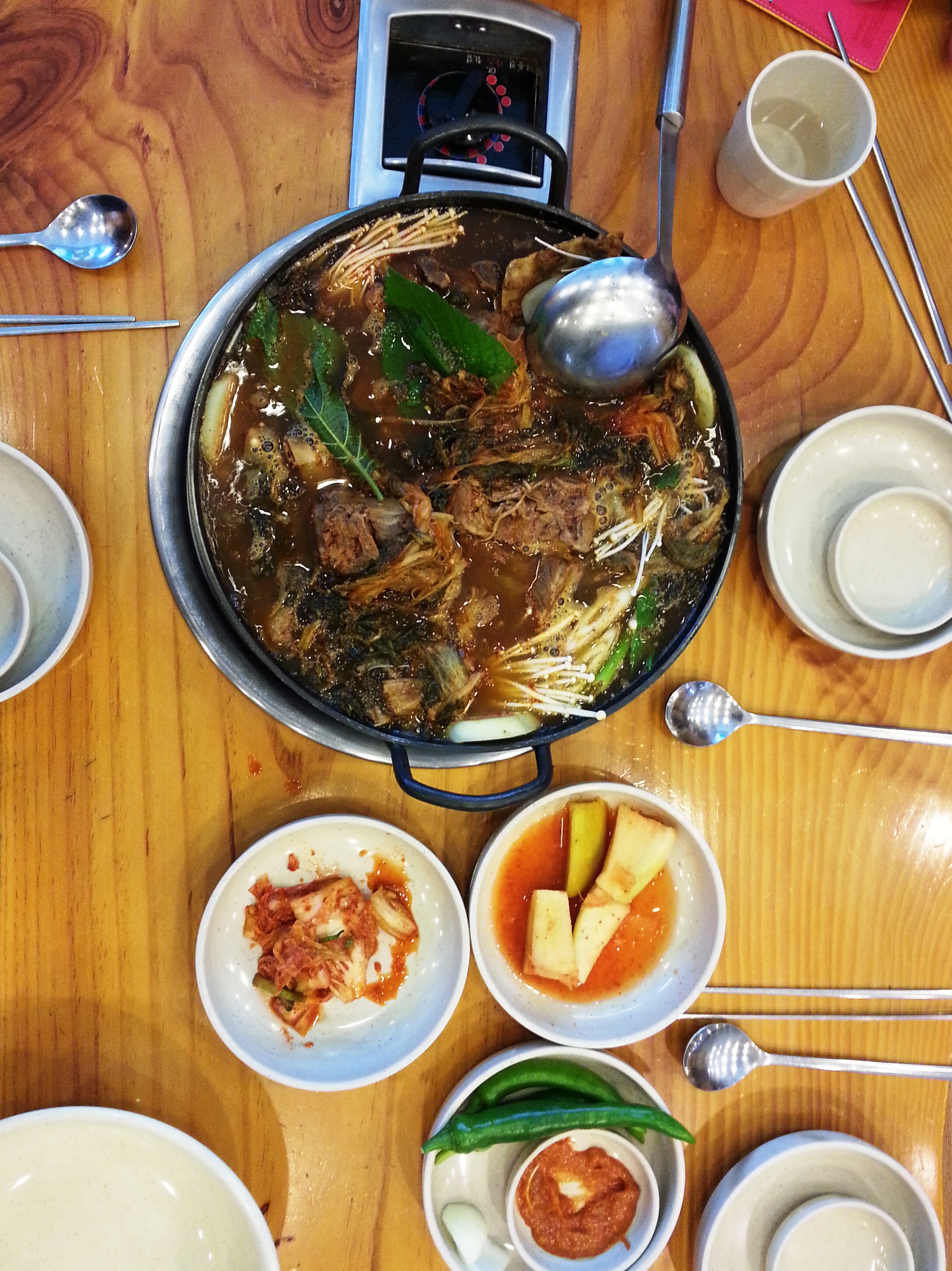
Gamjatang, a traditional Korean comfort food, is a spicy pork bone soup usually made with mushrooms, cabbage, potatoes, onions and perilla leaves. It gets it’s hearty flavor by boiling pork spine and seasoning it with plenty of chili paste and garlic. Gamja means potato and tang is a type of soup, so the name is a bit misleading as potatoes are not the main ingredient and sometimes nonexistent in the dish all together. I prefer gamjatang with potatoes but it’s delicious either way. So far this has been one of my favorite dishes.
While it’s commonly referred to as hangover soup, gamjatang is also believed to prevent snoring. I don’t snore–I don’t think–so I can not vouch for it’s ability to cure snoring but I can say it is indeed even tastier after an evening of consuming a few too many beers and sips of soju (don’t worry, Mom, that only happens occasionally).